27/Oct./2026
Center for Astronomy, Ibaraki University
Massive stars, which have masses more than eight times that of the Sun, play an important role in the evolution of galaxies. However, the formation processes of massive stars remain poorly understood because their formation regions are distant, complex, and often obscured by dense molecular clouds.
Since 2013, Ibaraki University has conducted high-cadence monitoring observations of 6.7 GHz class II methanol masers using the Hitachi 32-m radio telescope. These masers are known to be associated with the vicinity of massive protostars. From 2017 to 2022, the dual circular polarization modes: right-hand circular polarization (RHCP) and left-hand circular polarization (LHCP) of the maser were observed. The frequency offset between the RHCP and LHCP spectra provides information about the magnetic fields in massive star-forming regions.
In the presence of a magnetic field, the interaction between the magnetic field and molecular energy levels causes a small frequency offset between the RHCP and LHCP spectra. This phenomenon is known as Zeeman splitting, and the frequency offset is proportional to the line-of-sight component of the magnetic field. However, because methanol is a diamagnetic molecule, its Zeeman splitting is weak and difficult to detect, requiring high-sensitivity observations. To overcome this challenge, the team averaged the spectra obtained in each circular polarization mode over the five-year observation period to reduce noise. The team then calculated a cross-correlation function to measure the similarity between the two averaged spectra and identify the small spectral offset associated with Zeeman splitting.
The team analyzed 103 maser sources with signal-to-noise ratios exceeding 500 and successfully detected Zeeman splitting in 62 sources, including 38 new detections.
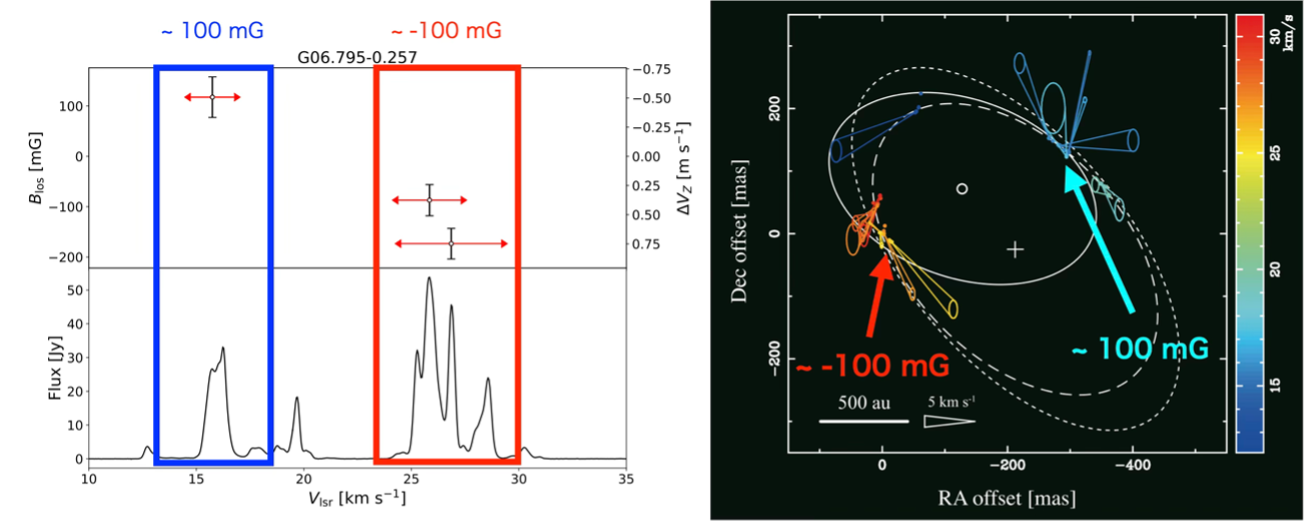
The left panels of the figure show an example of the results for G06.795−0.257. Previous research by Sugiyama et al. (2016) at Ibaraki University revealed that the methanol masers in this source originate from a disk wind launched from a rotating disk around a massive protostar, as illustrated in the right panel. The upper left panel shows the measured Zeeman splitting and the corresponding line-of-sight magnetic field components, estimated using the Zeeman splitting coefficient experimentally determined by Takagi et al. (2022). The lower left panel shows the maser spectrum averaged over the five-year observation period. The red and blue boxes in the left panels indicate the regions corresponding to the red and blue arrows, respectively, in the right panel. The measured Zeeman splitting has opposite signs in two regions located at different positions and moving in different directions. Using the experimentally determined Zeeman splitting coefficient, these measurements imply opposite signs for the line-of-sight magnetic field components in the two regions. This result may indicate that the magnetic field around the massive protostar is twisted by the rotation of the disk, giving rise to a complex magnetic field structure.
However, the interpretation of magnetic fields based on Zeeman splitting remains uncertain. Theoretical studies by Lankhaar et al. (2018) suggest that differences in the hyperfine structure of methanol may lead to different Zeeman splitting coefficients in different maser-emitting regions. This uncertainty affects the estimates of both the magnetic field strength and structure. To better understand the magnetic fields around massive protostars, future studies should compare observations of multiple methanol maser transitions, including the 12.2 GHz transition, with Zeeman splitting coefficients derived from both experimental measurements and theoretical calculations.
This research results have been published in Publications of the Astronomical Society of Japan (PASJ).